
Year: 2022
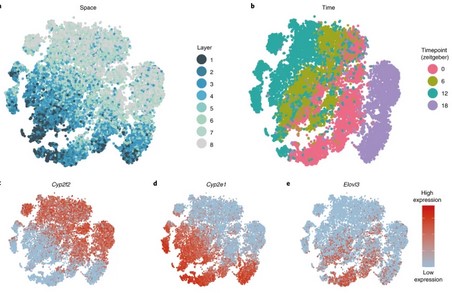
Space-time logic of liver gene expression at sub-lobular scale
The mammalian liver is a central hub for systemic metabolic homeostasis. Liver tissue is spatially structured, with hepatocytes operating in repeating lobules, and sub-lobule zones performing distinct functions. The liver is also subject to extensive temporal regulation, orchestrated by the interplay of the circadian clock, systemic signals and feeding rhythms. However, liver zonation has previously (…)
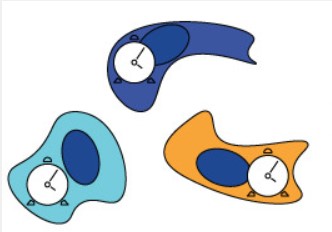
The circadian oscillator analysed at the single-transcript level
The circadian clock is an endogenous and self-sustained oscillator that anticipates daily environmental cycles. While rhythmic gene expression of circadian genes is well-described in populations of cells, the single-cell mRNA dynamics of multiple core clock genes remain largely unknown. Here we use single-molecule fluorescence in situ hybridisation (smFISH) at multiple time points to measure pairs (…)
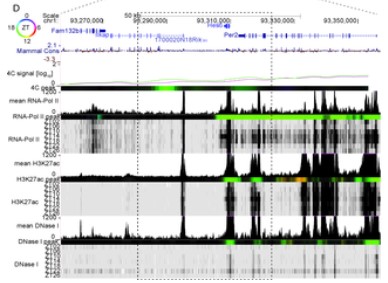
Oscillating and stable genome topologies underlie hepatic physiological rhythms during the circadian cycle
The circadian clock drives extensive temporal gene expression programs controlling daily changes in behavior and physiology. In mouse liver, transcription factors dynamics, chromatin modifications, and RNA Polymerase II (PolII) activity oscillate throughout the 24-hour (24h) day, regulating the rhythmic synthesis of thousands of transcripts. Also, 24h rhythms in gene promoter-enhancer chromatin looping accompany rhythmic mRNA (…)